
Checking Napa County Criminal History
No single public search produces a complete Napa County criminal record. Start with the source that created the facts in question. Napa Superior Court holds filed criminal cases and their dispositions. CJNet publishes recent booking, custody, release, and warrant information. Sheriff Records keeps sheriff reports, arrest warrants, and booking records, while each city police agency controls its own reports. A California DOJ Record Review is the official fingerprint route for a person checking their own statewide summary.
Gather a full name, possible aliases, date of birth, and any case or booking number first. Name spelling matters. The Napa court portal accepts names in last-name-first order and supports limited wildcard searches, but a similar name is not proof of identity. Compare the case date, charge, and court event with a second official record before drawing a conclusion.
- Search Napa Superior Court by a known case number or the person's correctly formatted name.
- Check CJNet when the issue involves a recent booking, present custody, release, or active warrant.
- Match identifiers and dates. Do not treat a shared name as a confirmed match.
- Request the police or sheriff report from the agency that made it when the public index lacks detail.
- Order court copies or use DOJ fingerprint review when an official personal record is needed.
Note: A citation can take up to three weeks to reach the court, so a fresh event may not appear at once.
Napa County CJNet Record Hub
The Napa County Criminal Justice Network, or CJNet, is the county's public operational record hub. Its separate reports answer distinct questions. The Booking Report covers the past week, the In Custody Report reflects people currently held, and the Release Report covers the past week of releases. CJNet also provides an SB 54 report and a warrant search. Each report carries a data timestamp, which helps readers judge how current the information is.
The official CJNet landing page shows how Napa County divides these searches.
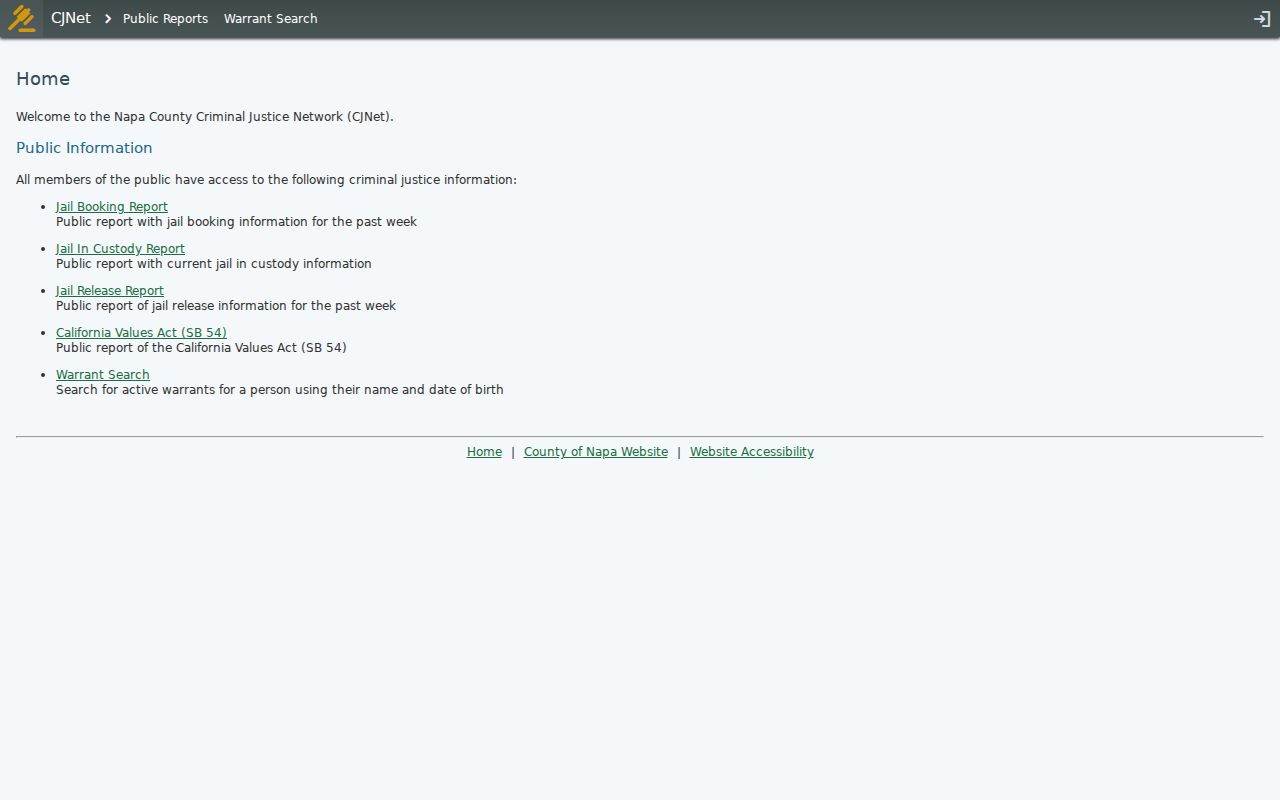
This county screen is a starting point, not a full criminal history. Booking data describes custody activity. It does not establish that prosecutors filed a charge or that a court entered a conviction.
| Question | Official channel | Key limit |
|---|---|---|
| Was someone booked recently? | CJNet Booking Report | Past week only |
| Is someone held now? | CJNet In Custody Report | Custody status can change |
| Was someone released? | CJNet Release Report | Past week only |
| Is a Napa warrant listed? | CJNet Warrant Search | Older or newly changed warrants may be absent |
| Was a criminal case filed? | Superior Court portal | Confidential cases excluded |
California Official Background Checks
California does not give the general public a DOJ name-search portal for another person's statewide criminal history. The California Department of Justice lets a person request their own record through fingerprint-based Record Review. The applicant completes form BCIA 8016RR, visits a Live Scan operator, pays the $25 DOJ processing fee plus the operator's rolling fee, and keeps the tracking number. Qualified California residents may seek a DOJ fee waiver.
The California DOJ Record Review instructions explain the official self-review process and how to challenge a discrepancy. This product differs from a Napa court search. DOJ compiles a statewide repository summary tied to fingerprints, while the court portal presents public Napa case-index and register information.
| Service | Known fee |
|---|---|
| DOJ Record Review processing | $25, unless waived |
| Live Scan operator rolling fee | Varies by operator |
| Court search taking over 10 minutes | $15 per search |
| Court printed copies | $0.50 per page |
| Court certified copy | $40 |
Tracing a Napa County Arrest
When the only known fact is that an arrest happened somewhere in Napa County, begin with time and custody. Search the CJNet Booking Report if the event was within the past week. Use the In Custody Report for present jail status and the Release Report for a recent release. If the entry has aged off those reports, ask Sheriff Records for the booking record or contact the arresting police agency for its report.
Next, search Napa Superior Court to learn whether prosecutors filed a case. A booking can exist without a filed charge, and a filed case may appear after the jail event. Napa Police arrests, American Canyon contract-police arrests, and St. Helena arrests all route to county corrections when booked. Their report copies still remain with the agency that made the arrest. This sequence keeps an arrest allegation separate from the court's later result.
Napa County Sheriff Records Bureau
Sheriff Records is the main fallback when a Napa County criminal record is not already in a public report. The bureau stores and retrieves official sheriff reports, booking records, arrest warrants, and statistical records. It also handles Public Records Act requests, Live Scan and ink fingerprints, and sex or arson registration for unincorporated areas and contract cities. Staff operate around the clock, but the public counter has weekday hours.
The Sheriff Records Bureau page identifies the work handled at 1535 Airport Boulevard.
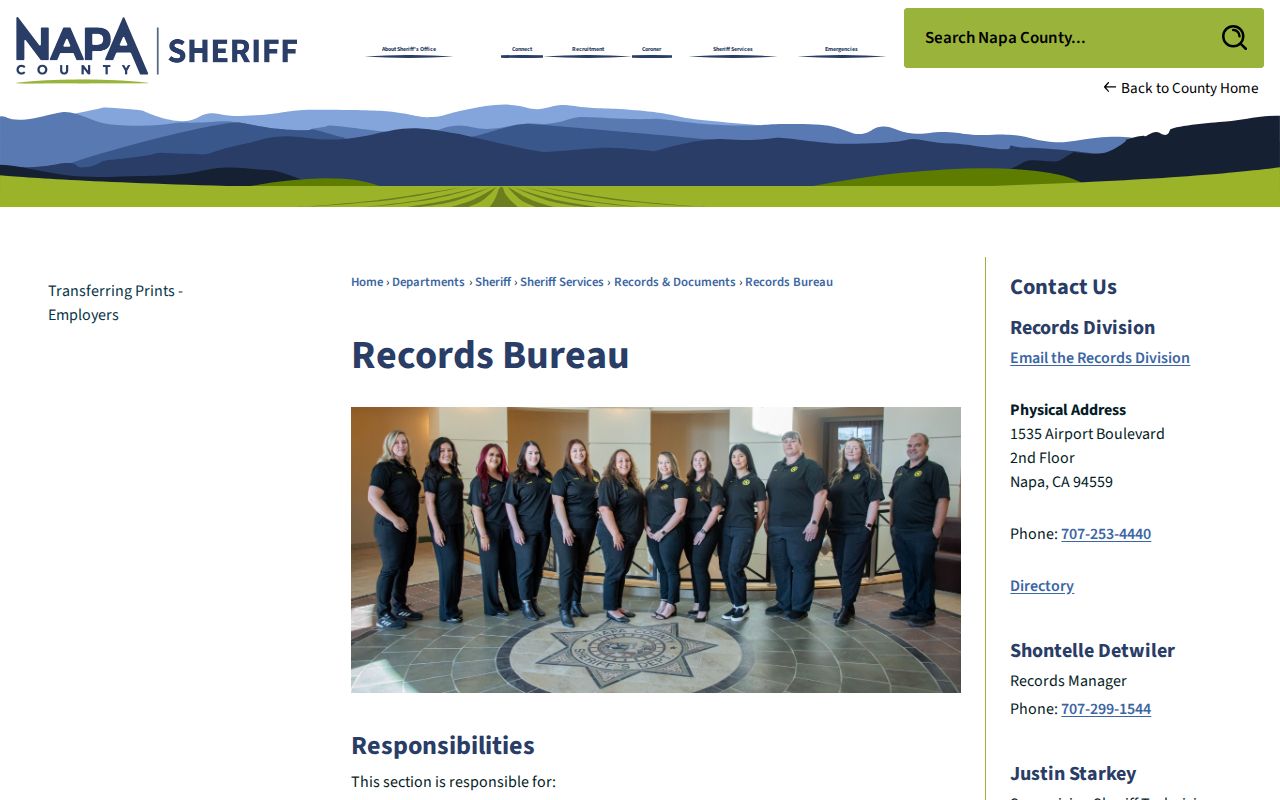
The bureau's broad role explains why a web search may be only the first step. A requester can call 707-253-4440, visit the second-floor counter Monday through Friday from 8 a.m. to 5 p.m., or use the county's online request process for a disclosable record.
The Sheriff records and documents page collects the request and service contacts.
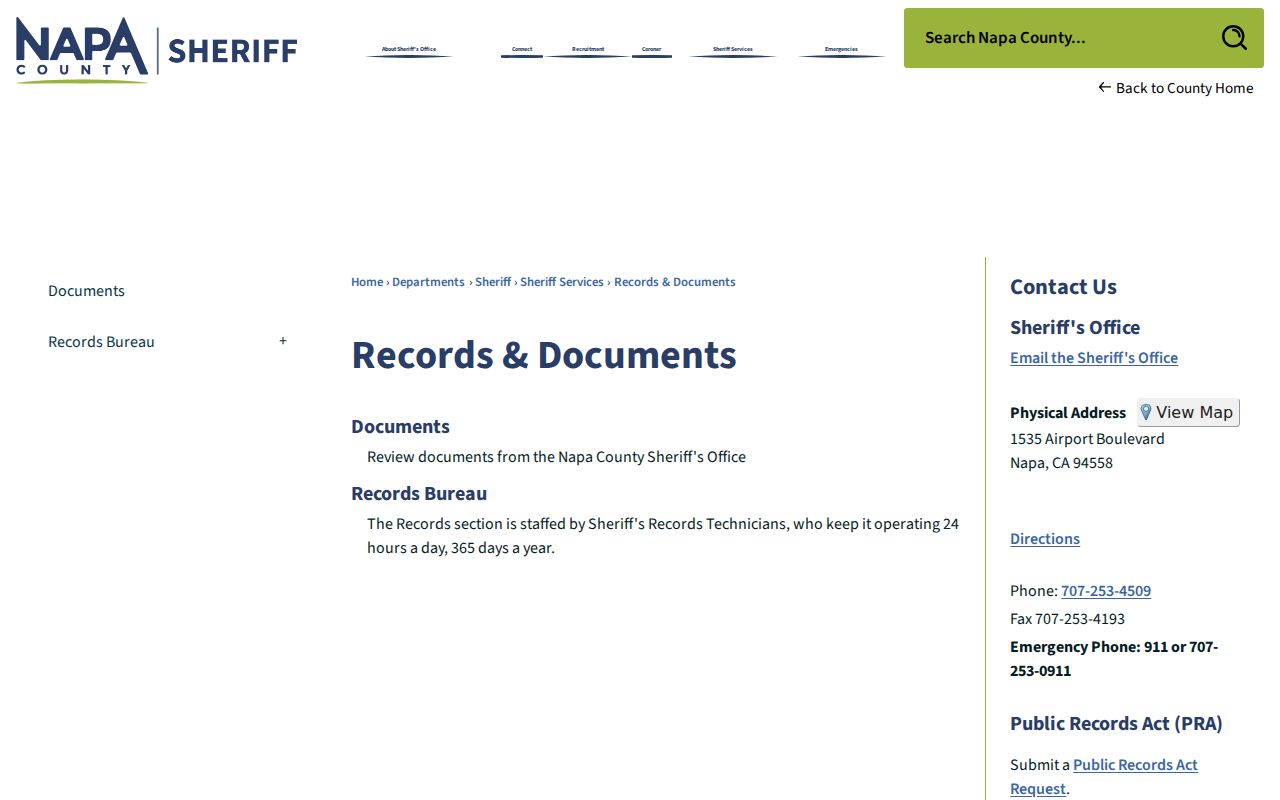
That contact block separates Records Services, Warrant Services, dispatch, and business functions. Choosing the right line can prevent a request from being routed through several units.
Sheriff Records Bureau
1535 Airport Boulevard, second floor
Napa, CA 94559
707-253-4440
Monday-Friday, 8 a.m.-5 p.m.
Criminal Court Counter
1111 Third Street, first floor
Napa, CA 94559
707-299-1180
Monday-Friday, 8 a.m.-4 p.m.
Criminal Record Types
A Napa County criminal history can include several record products created at different stages. Police and deputies write incident and arrest reports. Corrections creates booking and custody entries. The District Attorney decides whether to file a case. Napa Superior Court then records charges, hearings, rulings, dispositions, and sentences. Fingerprint events and later dispositions may reach the California DOJ repository, but timing gaps can leave a statewide summary without the latest outcome.
Probation files and CDCR parole records add another layer. A public court docket may show that probation was ordered or revoked, but that does not make the whole probation case file public. CDCR Search Population covers state custody and some status information, while the California Megan's Law Website is a separate public-safety registry.
- Incident and arrest reports come from the police agency or Sheriff that documented the event.
- Booking and custody records come from Napa County Corrections and CJNet.
- Criminal court files come from Napa Superior Court after a case is filed.
- State repository records come from California DOJ and are reviewed by the subject through fingerprints.
- Warrant, supervision, and registry records use distinct county and state systems.
Napa Court Records Differ
Napa Superior Court's Case Information Access portal is not a rap-sheet search. It indexes public cases filed in one county and excludes confidential cases. A DOJ Record Review, by contrast, is a fingerprint-based statewide summary for the person whose prints are submitted. CJNet is narrower still: it reports current or recent jail operations and listed warrants. Police reports describe an agency's investigation and may contain information that never becomes a filed charge.
The Napa court Case Information Access portal states its public scope and limits.
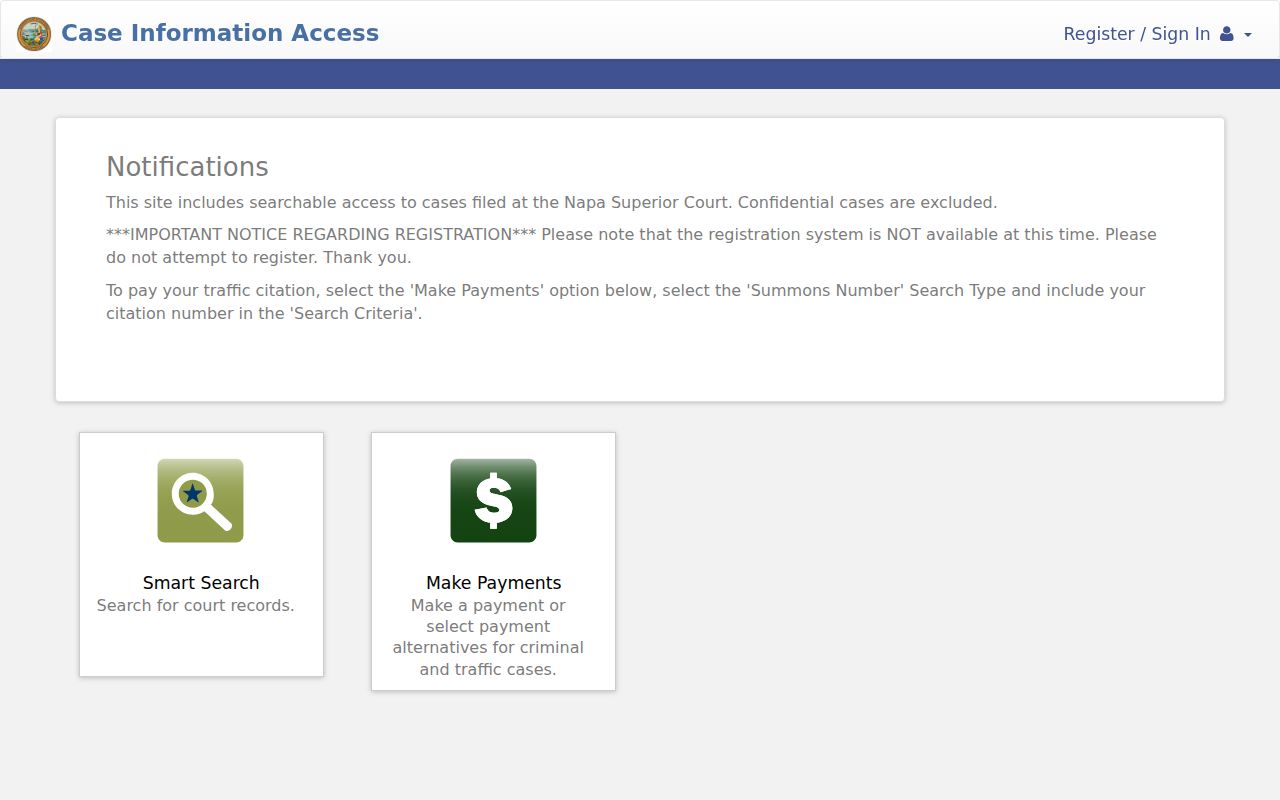
Use the court result to locate a case, then read the register and obtain needed copies. A dismissed case can still have a court record even though there was no conviction, and an old booking image can remain separate from later relief.
| Case number or name | Locates a court index entry; names use Last, First Middle Suffix format. |
|---|---|
| Case type and status | Distinguishes the kind of matter and whether it remains open or closed. |
| File dates | Narrows results to a useful period. |
| Charges and events | Shows allegations and docket activity, subject to public-access limits. |
| Disposition and sentence | Shows the court outcome when entered in the public record. |
Inside a Napa County Criminal Record
The contents depend on the source. A CJNet booking entry may show booking time, arrest information, booking type, charges, bail, and release data. A court file can show party identifiers, alleged statutes, hearing entries, pleas, rulings, disposition, sentence, and financial obligations. A DOJ summary links reported arrests and outcomes through fingerprints. None of these products should be read without its date and source.
| Name & Identifiers | Name, aliases, date of birth, case number, booking number, or agency identifiers when public. |
|---|---|
| Arrest / Booking Data | Agency, arrest facts, booking date and type, charges, bail, custody, and release fields. |
| Charges & Statutes | Alleged offenses and California code sections; an allegation is not a finding of guilt. |
| Disposition | The court's result, such as dismissal, acquittal, or conviction. |
| Sentence | Custody, fines, probation, or other orders after a conviction. |
| Custody / Supervision | County jail, CDCR, probation, or parole status from the proper source. |
- Charge
- An offense alleged by the prosecution, not proof of guilt.
- Disposition
- The court's outcome for a charge or case.
- Register of actions
- The court's dated list of filings and events.
- Wobbler
- A California offense that may be treated as a felony or misdemeanor under Penal Code section 17.
Napa County Court Copies
When online case information is not enough, the criminal clerk accepts a Criminal Record and Files Search Request by mail or in person. The form can request copies, certified copies, sentencing information, or specified documents. Give one name per request. Each alias needs its own form, and daily research is limited to ten names or ten case records. Files pulled for inspection are held for ten days after notice.
The Napa court research and records page explains the clerk's search rules and fees.
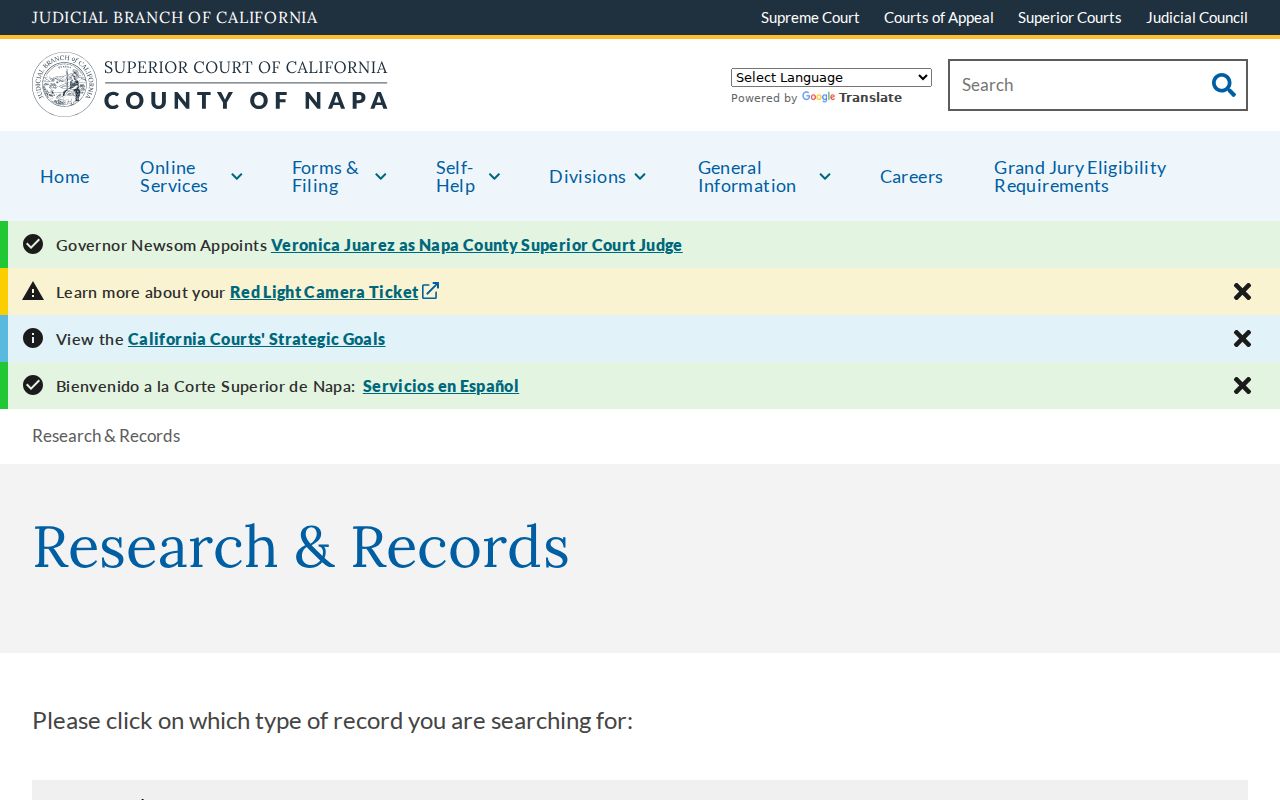
The page also routes criminal, traffic, and minor-offense records to 1111 Third Street, not the Historic Courthouse records counter at 825 Brown Street. Telephone access is narrower and limited to authorized callers.
The Napa Superior Court homepage identifies the county court and its services.
Use that official court source for location changes and current notices before planning an in-person request.
Public Access Laws in California
The California Public Records Act provides a path to disclosable records held by Napa County agencies, but it does not make every criminal-history detail public. Penal Code section 11105 controls access to state summary criminal-history information. California court rules set the scope of remote electronic access, including public indexes and registers while protecting confidential matters. These rules explain why the court portal, a sheriff response, and a DOJ record may contain different amounts of information.
Key California laws:
California Public Records Act provides access to disclosable agency records and preserves exemptions.
Penal Code section 11105 limits dissemination of California DOJ summary criminal-history information.
California Rule of Court 2.503 sets the scope and limits of electronic court-record access.
California Rule of Court 2.507 governs electronic calendars, indexes, and registers of actions.
Penal Code section 1203.4 provides dismissal relief after qualifying completion of probation or sentence.
The Napa County NextRequest portal is the online route for county Public Records Act requests when no direct report or form covers the need. Describe the record, date range, agency, and known identifiers narrowly enough for staff to locate it.
The Napa County public records request portal accepts those submissions.
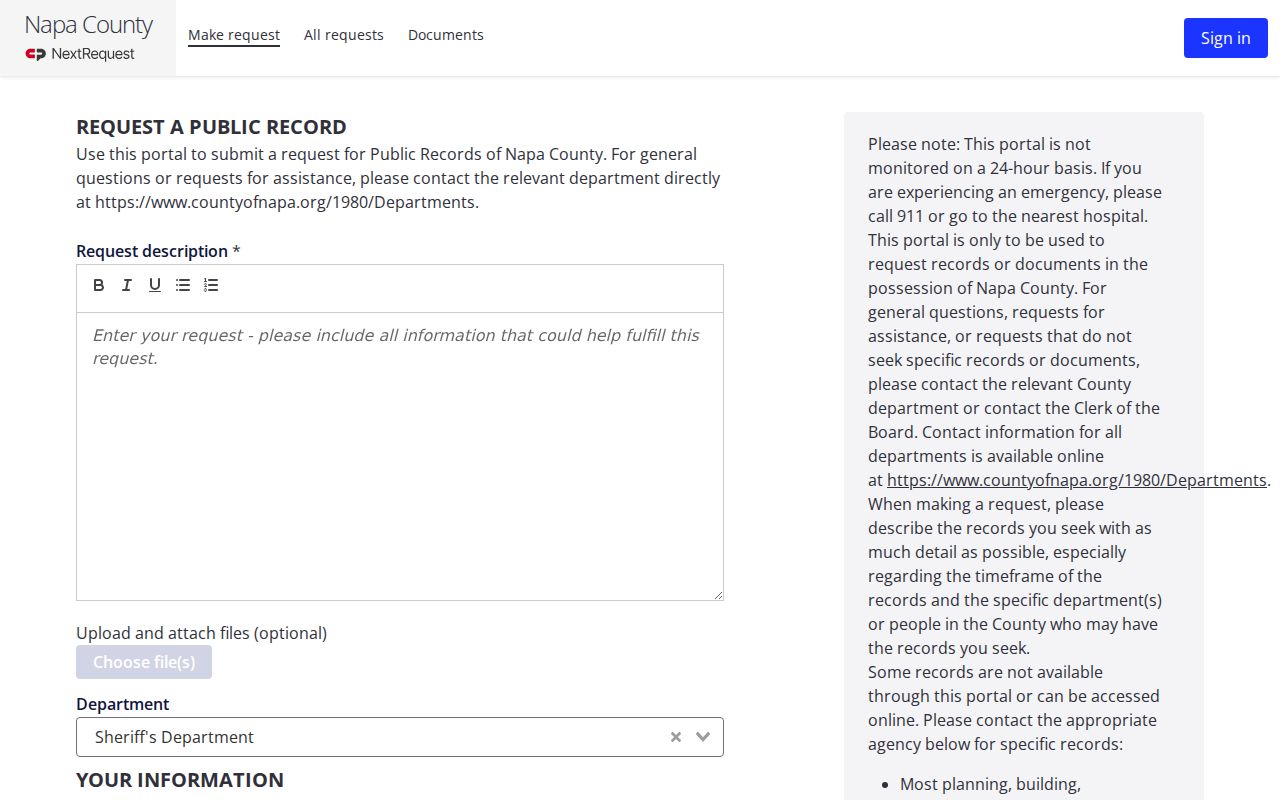
This request form fills gaps in published material, but release still depends on California law and the facts of the record.
Napa County Warrant Resolution
CJNet's warrant search asks for first and last name and allows an optional birth year. A selected year can include matches within three years on either side, so the result must be checked with care. The county warns that recent changes may not yet appear and that warrants issued before January 1, 2006 may be missing. Warrant Services at 707-253-4209 is the official fallback.
If the listed warrant is yours, CJNet directs you to the Criminal Division counter at 1111 Third Street at 8:30 a.m. or 1:30 p.m. The clerk assigns a courtroom. Failing to report there leaves the warrant outstanding. No one should try to apprehend another person based on a web result.
Note: Warrant information can change at any time, so confirm it with Napa County Warrant Services before relying on a result.
Sealed, Expunged, and Restricted Records
Some Napa County criminal records are not open to general public review. Juvenile delinquency files, sealed matters, protected victim information, and other confidential records can be withheld from online and counter access. The court portal says confidential cases are excluded. An absent result may therefore reflect a legal restriction, a filing delay, or a search mismatch rather than proof that no record exists.
California commonly calls Penal Code section 1203.4 relief an expungement, though the statute provides a dismissal or set-aside after qualifying completion. It does not erase every trace from every system. A booking record, court docket, and DOJ summary are separate products. Other sealing and automatic-relief laws may apply to selected arrest or conviction records, and access can remain available to authorized agencies.
For an error in your own statewide summary, use California DOJ's record-review challenge route. For a wrong or incomplete Napa court entry, contact the criminal clerk and identify the case. Police and sheriff reports must be addressed with the agency that created them.
Napa County Custody and Supervision
Napa County Corrections operates the local jail path at 2210 Napa-Vallejo Highway. The county custody report links back to CJNet, while corrections provides separate information on visitation, mail, and deposits. A local jail record should not be confused with a California prison record. CDCR Search Population, also known as CIRIS, is the state route for people in CDCR custody and some state status information.
The Napa County Corrections page connects readers to local custody services.
This official page helps separate jail logistics from court files and statewide prison information.
The California Department of Corrections and Rehabilitation links its state Search Population service.
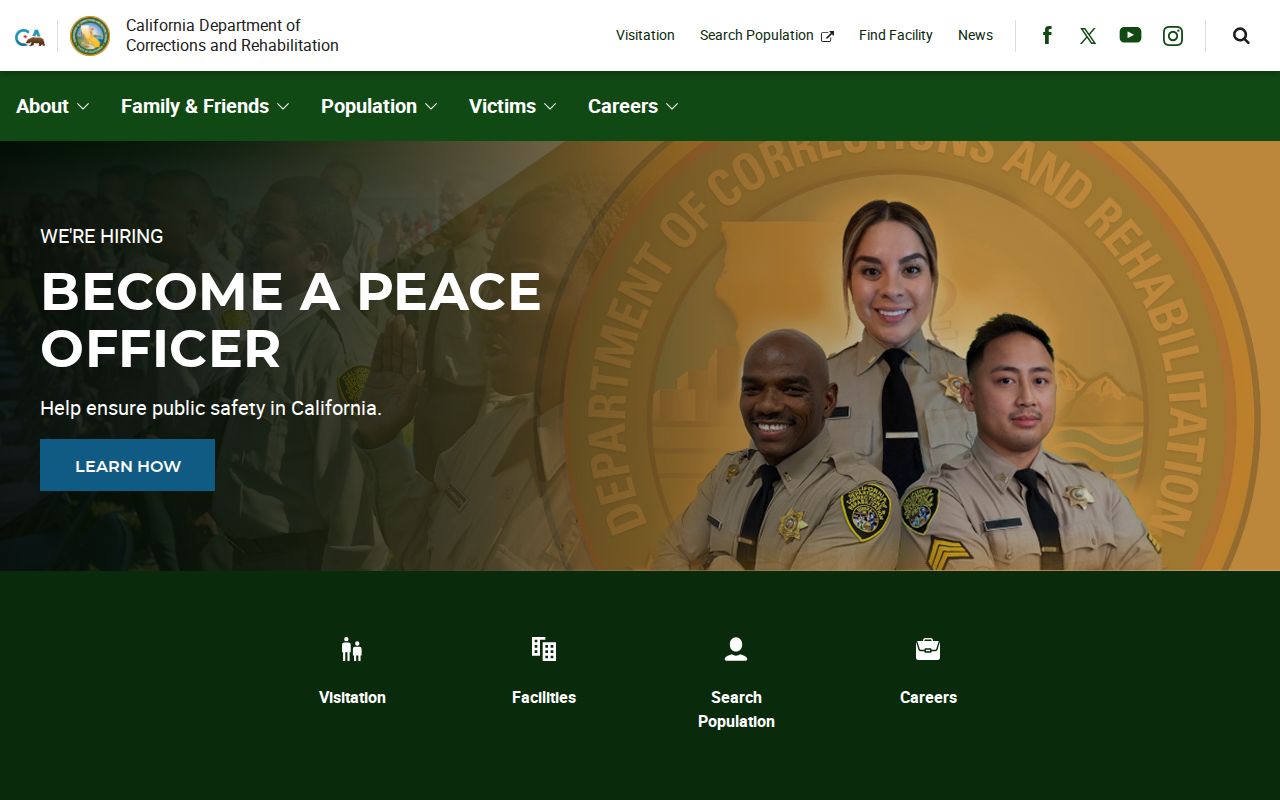
Napa County Adult Probation is county-run at 555 Gateway Drive, while parole field supervision is handled by CDCR's Division of Adult Parole Operations. A court case may show a probation sentence or revocation event, but it is not the same as the department's supervision file.
Napa County Criminal Records by City
City police reports follow the agency that created them, while booked arrests and filed cases move into county systems. Napa Police keeps city reports and local record-check requests. American Canyon contracts with Napa County Sheriff, and original crime and traffic reports are held by Sheriff Records. St. Helena runs its own Police Records process. Criminal prosecutions from all three cities go to Napa Superior Court, not separate municipal criminal courts.
Napa Criminal Records
Population 76,562 · Napa Police reports, CJNet bookings, and Superior Court cases use separate channels.
American Canyon Criminal Records
Population 22,773 · Contract policing routes original reports through Napa Sheriff Records.
St. Helena Criminal Records
Population 5,194 · St. Helena Police accepts report requests by online form, mail, drop-off, or email.
The court's case lookup and self-service page provides the countywide route after a city matter becomes a filed case.
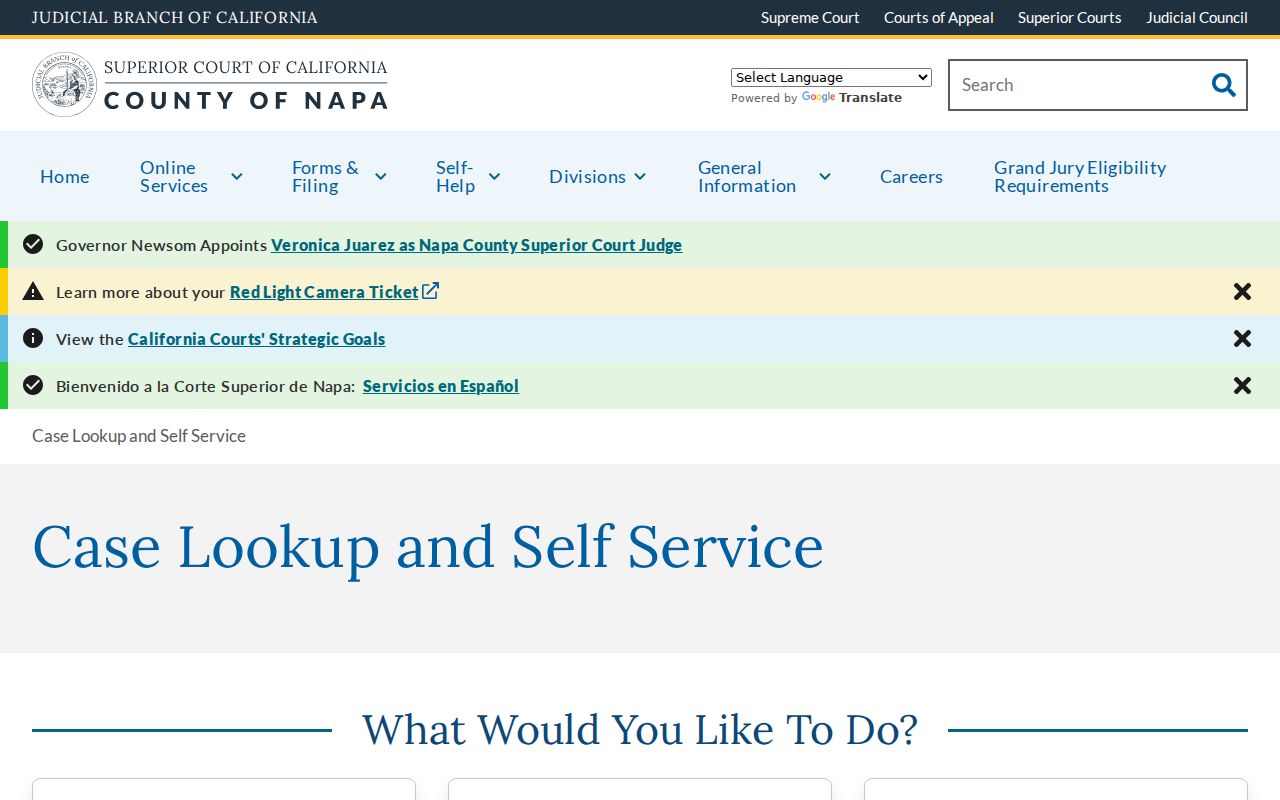
This shared court channel is the link between local enforcement records and the judicial outcome.